Panegyric
Panegyric was a project that ran between Spring 2021 and Spring 2022. It was developed for Arts and Heritage’s Meeting Point programme, an initiative that sought to mediate between heritage sites and artists across the UK. We worked with Naseby 1645, an organisation that looked after the site of the Battle of Naseby, one of the most significant battles of the English Civil War.
We were drawn to the somewhat hidden history of the battle. It was a pivotal moment in the English Civil War and, arguably, marking the beginning of the victory of Oliver Cromwell’s Parliamentarian New Model Army. Now it is a field amongst many others that stretch out between Kettering and Rugby.
We were curious about many parallels between the England of the Civil War and contemporary Britain. We developed our proposal in 2020, when Britain was still reeling in the aftermath of Brexit, and weeks before the outbreak of the pandemic. We wanted to explore Naseby against this background of contemporary division and fissure, and also, as Covid-19 cases exploded during 2020, to explore how discourses and lived realities of illness, death and decay played out both in Covid Britain and during the Civil War.
The project started with the notion of the Panegyric. This was a form of ballad, often sung, written in praise of a political leader or idea. During the Civil War era, both in the lead-up to conflict and throughout the war itself, panegyrics were written in praise of both royalist and parliamentarian causes.
Tom and I are both songwriters, and we were very curious about this form of activism through song, and about the notion of praise. Our early ideas were to work with local community members to develop panegyrics about their life in contemporary Naseby, and for these songs to form part of the project.
We were also drawn to the more ephemeral and ineffable aspects of the Civil War era and how the social, spiritual and national collective consciousness was so different to C21st Britain. It was a religious war as much as anything, and Britain was a society steeped in arcane beliefs. It was also an era of heightened radicalism and new thinking.
We wanted to capture something of this strange swirl of ideas and dreams that were rolling around the island. We found Anne Bradstreet’s incredible poem A Dialogue between Old England and New, written during the Civil War by Bradstreet, a Northampton resident who had recently moved to America, as a way to understand the almost apocalyptic breakdown within the country. Her poem is visionary and vivid, painting a picture of a country broken by difference and disease. We knew we wanted her words to be part of the work we made.
We were also inspired by more contemporary takes on the era. We were inspired by Ben Wheatley and Amy Jump’s A Field In England’s hallucinatory vision of the 1600s with its droning synths, and also the depiction of the period in 1970s horror films such as The Witchfinder General and the hauntological undertones of the horror imagery and soundscapes. We were also inspired by recent books such as The Manningtree Witches by AK Blakemore, as well as Christopher Hill’s account of the radicalism of the period, The World Turned Upside Down.
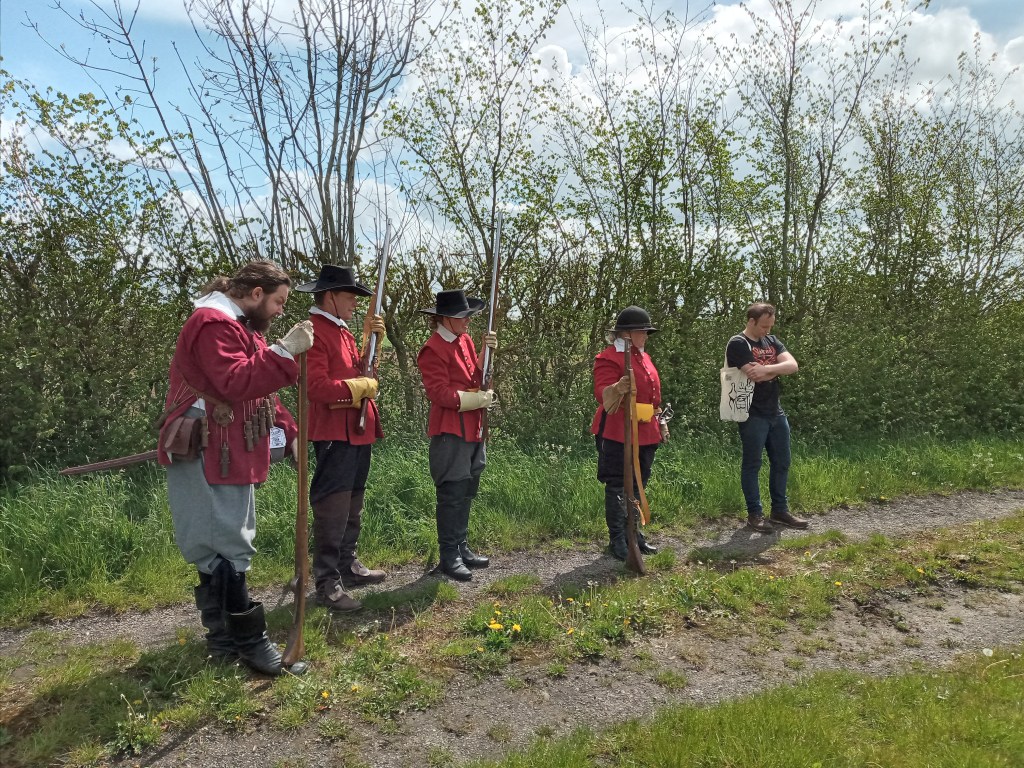
So, we started a process of meeting and gathering, of building up materials, sounds and images. We spent a weekend with The Troop – a group of mounted battle re-eanctors led by Alan Larsen – filming and recording them running manoeuvres across the actual site of the battle.
We also spent time in Naseby Church recording sound and music with Nottingham based collective R10, and musician Andy Blake, who plays Civil War-era instruments including the Lezard and pipes. The process was captured by filmmaker Paul Barritt who rendered the loops and segments featured in the film.
During the summer we spent a number of days with two primary schools, one in Naseby, and the other in Farndon Fields, both positioned on significant sites in the history of the battle. We worked with the children to develop their own panegyrics – creating verses about what they loved, and then translating these into drum rhythms and poems. We also developed soundscapes of the battle using voice, working with the children to listen the history out-loud.
These elements all became part of the project’s two outcomes – a live performance, and this film. The live performance was in Naseby Church during spring 2022. We performed the songs with the films of our collaborator Paul Barritt projected alongside us. We also invited the R10 Collective to perform. Naseby 1645 organised a battle reenactment earlier in the day and we were joined onstage by reenactors to discuss drumming techniques.
This film is a another “version” of the project. It views the footage through a kaleidoscope made from an image of a civil war drum; the history of Naseby is viewed from a distance – hallucinatory and partial. You’ll hear the children’s voices as well as the soundscape of the battle-site itself. The voiceover for the battle-scene is taken from a contemporaneous account entitled Anglia rediviva, written by the victors but vivid in its journalistic detail. The music is a mix of song, with words from Anne Bradstreet, and improvisation sessions recorded we recorded in Margate with Paul Barritt.
We hope it captures something of the site itself, both its banality and its mystery. We also hope it does justice to the custodial work of re-enactment groups who hold memory through embodying history so rigorously and generously.
Whilst the film has the feel of a lament, we want to hold up the notion of the nation for active critique. The idea of nationhood is riddled with hypocrisy and ugliness, and many of the more radical ideas at play during the Civil War pointed towards more utopian ways of organising. These ideas are still present and relevant today and deserve reappraisal. We hope the film helps us look forwards rather than backwards. Perhaps a world that is post-England, post-nation and post-borders, slipping these endless debates between England, new or old.
Panegyric: Film
 danny scott